
A forest of their own: Makahu School plants for the future at Patui

At the edge of a Taranaki wetland, sixteen children are growing a forest they will know for the rest of their lives.
Makahu School is a small rural primary school — all sixteen pupils of it, led by principal Chris Mattock, who is both the head of the school and its main teacher. Over this year they have made Patui, one of our reserves in the Taranaki hill country, their outdoor classroom, returning every few months to see how the land is changing and to play their part in its restoration.
Twenty-five tōtara, each with a name
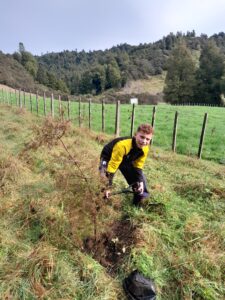
When contractors planted 750 native trees and shrubs at Patui this winter — turning recently retired marginal farmland back into the native forest that once covered these hills — an area was set aside just for the school. In it, the children planted 25 large tōtara and 50 flax of their own.
Then came the part they will remember. Each child fixed a small, permanent metal tag to their own tōtara.
It is a simple thing, but it changes everything. That tree is no longer just a tree in a reserve — it is theirs, named and known, waiting for them when they return. Every few months they return to find it a little taller, a little sturdier, a little more like the forest giant a tōtara becomes over centuries. These are children who will be able to bring their own children here one day and put a hand on a tree they planted, and say: ‘that one is mine’.
A tōtara can live for more than a thousand years. The sixteen children of Makahu School have just started something that will outlast all of us — and because Patui is protected for ever, that legacy cannot be undone.
The kōura that stole the show
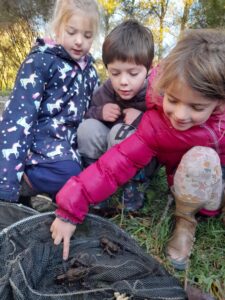
On one visit, the children carried out a survey of the reserve’s wetland with Dean Caskey of the Taranaki Regional Council. Wading in to see what lived there, they caught — and carefully released — several large kōura (New Zealand’s native freshwater crayfish).
And not just any kōura. Several were carrying eggs beneath their tails, which is a quietly wonderful sign: it means the wetland is healthy enough for kōura not just to survive, but to breed. Kōura are a taonga species found only in New Zealand, and they are among the first to disappear when native bush is cleared and wetlands are drained. Finding egg-carrying kōura at Patui tells us, better than any report could, that this land is coming back to life.
For the children, of course, the science came second to the sheer delight of holding a large, egg-laden crayfish in cupped hands before letting it slip back into the water. It is the kind of moment that turns a school day into a memory — and a child into someone who cares about wild places.
Chris Mattock’s own verdict was brief and warm. “Loving the place up there,” he told us. “They enjoyed the day very much, so thank you.”
That thank-you isn’t really ours to keep. Patui is a reserve because supporters bought and protected it, and it will still be there in a hundred years for the same reason. The children get their outdoor classroom, and their own tōtara to come back to, because a group of people they will never meet decided this valley was worth saving.
Why this matters
This is what protecting land for ever really makes possible. Patui is not a museum piece — it is a living, working reserve where a new generation is learning, planting, wading into wetlands and watching their own trees grow. Restoration is not only about the forest we save today; it is about the people who will love and look after it long after we are gone.
We are so grateful to everyone whose support makes reserves like Patui possible — and to Makahu School and Dean Caskey for sharing their year with us.
If you would like to help keep places like Patui growing for the next generation, you can support our work here. Every gift helps protect and restore New Zealand’s native forests and wetlands for all New Zealanders, for ever.