Hutiwai: the forest you helped save takes its first steps toward permanent protection

Some of you will remember Hutiwai — 434 hectares of native forest and wetland in the hills of North Taranaki, above the Tongaporutu coast, that we set out to buy and protect. It is tawa and kamahi forest threaded with beech, valley-floor wetland, and the recovering scars of former pine plantations that we always believed could return to native forest. It is home to kiwi and the rare yellow-crowned parakeet, and it sits shoulder to shoulder with the DOC-owned Hutiwai and Mohakatino Conservation Areas — country that also holds whio, and long- and short-tailed bats.
Hundreds of you helped us bring it into the Trust’s care. We wanted to tell you what has been happening there since.
A closer look at what lives here
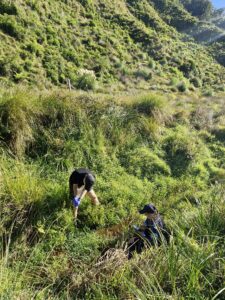
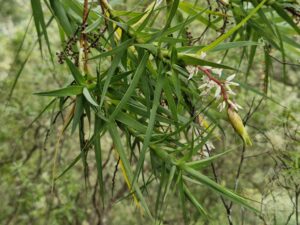
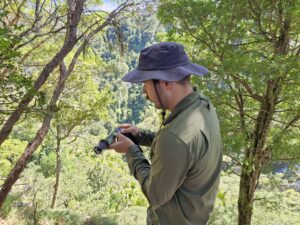
In March, staff from Taranaki Regional Council, the QEII National Trust and NFRT walked Hutiwai together for a proper look at what the forest holds. It was the kind of day that reminds you why this land was worth saving. The team took eDNA samples from the wetland — a way of reading the water for the species that pass through it — and set up a bat detector to listen for what moves through the bush at night. A dracophyllum was photographed in flower. In the foreground, young mānuka was coming away in the light; behind it, Mt Taranaki stood over the whole valley.
Every visit like this tells us a little more about the wildlife your support is protecting — and there is almost certainly more here still to find.
The first steps toward “for ever”
Here is the part we are most quietly pleased to share. The QEII National Trust has approved Hutiwai to proceed to covenanting — the process that leads to permanent legal protection. That process is now underway. The process is not yet complete. Covenanting is careful, considered work, and it takes time. But the ball is rolling, and the direction is the one that matters most to us — toward the day Hutiwai is protected for all New Zealanders, for ever.
Alongside that, Taranaki Regional Council is writing a biodiversity plan for the site and will help co-fund the restoration work there. That partnership is important. It means the care of Hutiwai isn’t resting on the Trust alone — it has independent backing from people who know this landscape well.
And there will soon be something to see on the ground, too. A new interpretation sign has been designed for Hutiwai — a small thing, perhaps, but the kind of thing that turns protected land into a place people can arrive at, explore and understand.
Thank you
None of this — the field visit, the covenanting process, the biodiversity plan, the sign — would be happening if Hutiwai were still just another block of unprotected forest on the open market. It is happening because hundreds of supporters decided this place was worth keeping. That is the whole of it: you loved a forest you may never have stood in, and you acted, and now its future is being made safe.
We’ll keep you posted as the covenanting process moves forward. In the meantime, thank you — from all of us, and from the kiwi calling somewhere in the dark.
If you’d like to help protect and restore more places like Hutiwai, you can donate here. Every gift helps us protect another special place.