
A living memorial: how Elizabeth Oliver honoured her brother Jack

Some gifts arrive as a sum of money. This one arrived as a wish: that somewhere in a New Zealand reserve, a grove of pūriri would grow, and keep growing, carrying a name that waited eighty years for a place of its own.
Elizabeth Agnes Oliver died in Auckland on 13 September 2022, aged 94. She was born in Napier on 10 April 1928, the second child of David Jack Oliver and Olive Oliver, née Moss. Their first was a son, Jack Moss Oliver — a name now planted, quite literally, into land the Trust protects.
The brother
Jack was born in Napier in April 1921 and went to Napier Boys’ High School, where he passed his University Entrance, played in the first XV and swam and played tennis. Afterwards he turned out for the Napier High School Old Boys, studied accountancy by correspondence, and took a job as a clerk in the Public Trust Office in Wellington. An ordinary, promising life, of the kind his generation was not allowed to finish.
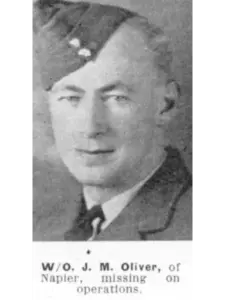
He applied for aircrew training in March 1941 and went into camp that December. The route took him from the ground training school at Levin to elementary flying training at New Plymouth, and then, in April 1942, out of the country — to Canada, under the Empire Air Training Scheme. He learned to fly at Brandon in Manitoba, took his flying badge and his sergeant’s stripes that August, went on to general reconnaissance school at Charlottetown on Prince Edward Island and operational training at Patricia Bay in British Columbia. In June 1943 he sailed for Britain, and in October, after a torpedo course at Turnberry in Ayrshire, he was posted to No. 489 (NZ) Squadron at Leuchars in Fife.
489 was a New Zealand squadron flying Beaufighters under RAF Coastal Command, and its work was shipping. For four months Jack flew rover patrols off the Norwegian coast. On one of them he attacked two enemy merchant ships escorted by three warships. He was promoted to Warrant Officer on 28 February 1944, and flew further patrols through March.
On 1 April 1944 he took off as pilot of a Beaufighter on an anti-shipping patrol off the coast of Norway. The aircraft did not come back. He was recorded as missing, believed killed. He had flown 453 hours. He was twenty-two.
Nothing was ever found. There is no grave. His name is cut into the Runnymede Memorial in Surrey — Panel 263 — among more than twenty thousand airmen of the Commonwealth lost with no known resting place.
The sister
Elizabeth was fifteen when the telegram came, nine days short of her sixteenth birthday.
Her own childhood had already been harder than most. She was not yet three when the Napier earthquake struck, and she remembered all her life the house being shaken off its foundations. From the age of eleven she lived with complex medical conditions, including six months in Napier Hospital in 1941, and with considerable discomfort for the rest of her life. She went to Iona College in Havelock North as a boarder in 1943, and the following year her brother was lost.
Not killed — missing. There was no body, no grave, no certainty, and no end to it. A friend who knew her in later life recalled that Jack’s loss was a profound grief, for Elizabeth and for her parents both, and that she carried for the rest of her long life the wish that her brother might one day have a memorial of his own.
A life spent making sure things were not lost
What she did with that life has a symmetry it is hard to miss.
She went to Wellington after school, enrolled at Victoria for an arts degree and never finished it — she was, by her own admission, hopeless at examinations, and the drama club had her instead. A friend suggested the National Library, and there she found the work she would do for the next forty years. One of her first jobs was to build a library service for the tuberculosis wards at Wellington Hospital, going round the beds with a trolley of books she had chosen herself; she became, by every account, a welcome visitor. She had spent six months of her own childhood in a hospital bed. She gained her New Zealand Library Association Certificate in 1955.
In 1958 she sailed for Canada — where cousins on her father’s side lived, and where her brother had done his flying training — and worked at the big downtown branch of the Toronto Public Library, travelling in her holidays through Canada and Mexico. Home again, she became Municipal Librarian in Auckland. She spent the last seventeen years of her working life as librarian at the New Zealand Insurance Company, where she taught herself to search the new online databases and gave her researchers an edge nobody else had.
Outside work it was the same instinct, over and over. She helped strangers trace their families at the Latter-day Saints family history centre. She compiled a register of New Zealand’s Scottish immigrants. She belonged to the Scottish and Welsh family history groups, the Archives and Records Association, the Historic Gardens Society. Fellow researchers remembered her as “a fountain of knowledge”, and remembered her patient, repeated instruction to every newcomer who came to her for help: document your sources.
She spent four decades making sure names, records and stories could be found again by whoever came looking. Her own brother could not be found at all.
The last of the family
Her father died in 1966 and her mother the following year. With that the link to Napier was cut, and Elizabeth stayed in Auckland for good. She bought a historic cottage in Mount Eden, made it her own, kept cats, and became a keen gardener — her first garden, flowers and vegetables growing in together.
She never married and had no children. She had a wide, busy life: an art collection, a snuff box collection displayed just so, afternoon teas at home after meetings, and holidays that took her to Britain, Egypt, China, Greece, Turkey, Thailand, Indonesia. She was a deep thinker who loved to expound a theory, did not suffer fools, and was — her friends were clear on this — thoughtful and entirely without judgement. She spent her last nineteen years in a villa at an Auckland retirement village, with her books and her antique furniture and the talkback radio at full volume.
But she was the last of the Olivers. When she died there was no one left in the family to remember Jack. So before she went, she made the remembering permanent.
Why pūriri
In her will she asked that the Trust establish a grove of pūriri, to be known as the Jack Moss Oliver Memorial Grove, in her brother’s memory. She asked her friend Gail Griffin to plant one of the trees for her.
That she chose pūriri tells you something. As one of our trustees observed, she clearly knew her New Zealand trees. It was a thoughtful choice: a tree found only in New Zealand, long-lived, generous to wildlife, and itself once greatly diminished.
Pūriri grows nowhere else in the world, and in New Zealand only across the warm top half of the North Island. It is our most generous tree: some flowers almost all year round, heaviest through the depths of winter when little else is in bloom, and ripe fruit through the summer. It feeds tūī, korimako and kererū in the lean months when other trees have nothing to give — and kererū matters more than most, being the only bird we have left big enough to swallow and carry the large fruits of our forest trees. Old pūriri become habitats in themselves, their wide gnarled limbs carrying perching astelia, puka and young northern rātā.
It is also a tree this country came close to losing. Pūriri grew on the best soils, so its forests were among the first burned for farmland; and its timber is so hard, and so durable in the ground — fifty years and more, untreated — that it was cut out for fence posts, railway sleepers and house blocks until, by the mid-1940s, the supply was all but exhausted, and the great lowland pūriri forests with it. Those gnarled old trees standing alone in paddocks across Northland and Auckland are what is left of them.
So a grove of thirty pūriri is not a decorative gesture. It is a piece of a forest type we nearly erased, put back where it belongs, on land that cannot be cleared again.
The grove at Tupare
In the winter of 2024 the wish became real.
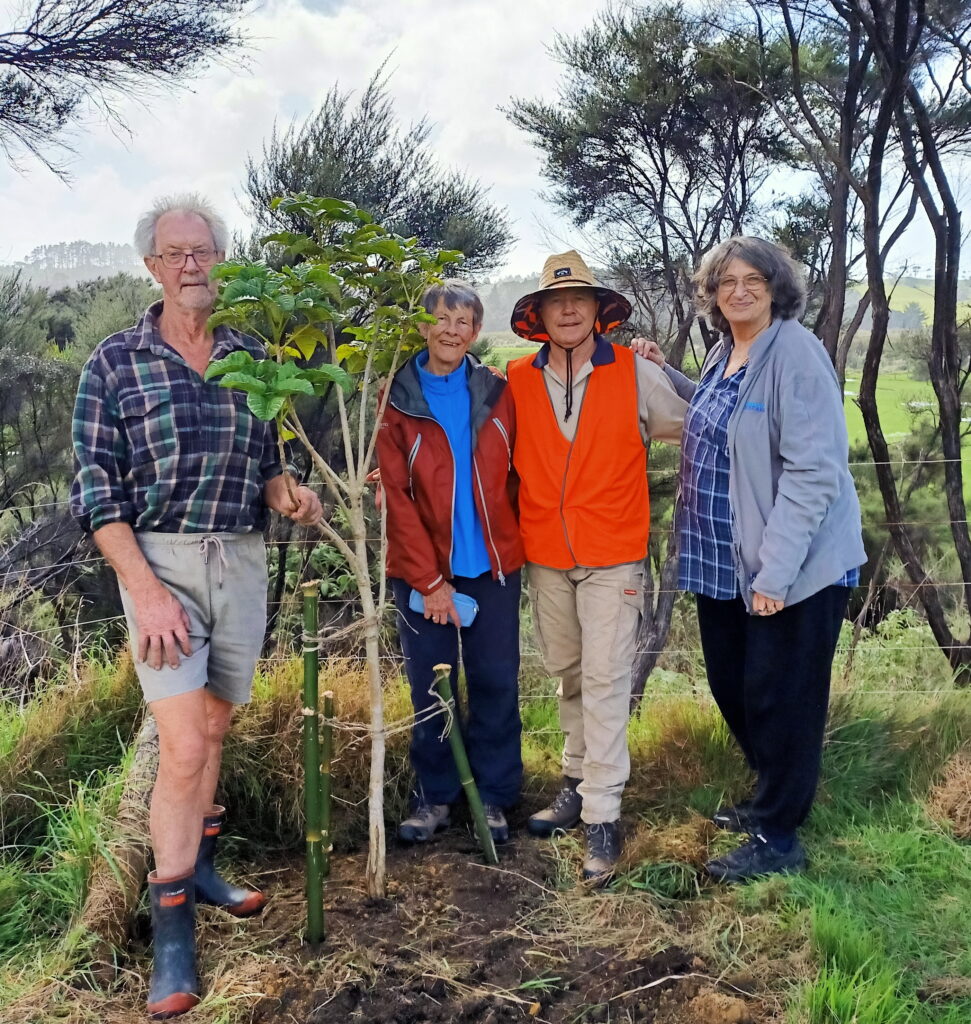
The Trust’s Marie Neverman Wetland lies at Tupare, near South Head on the Kaipara Harbour — our closest reserve to Auckland. Above the wetland a headland rises, drier and higher than the gallery forest around it, looking out over the water. There, around thirty pūriri were planted to form the grove Elizabeth had envisaged. Trustees joined her executors and friends Gail Griffin and Diana Rabone, for a quiet ceremony to plant them.
There is a deeper resonance to the place. Marie Neverman Wetland exists at all because of another New Zealander who left a gift in her will — the reserve was first bought with a legacy from the estate of Marie Neverman. A generation on, another woman’s bequest grows on the same protected ground. That is how these places get built: not all at once, but gift by gift, name by name, across decades. Elizabeth’s own bequest did more than plant a grove — it also helped make the purchase of Hutiwai possible, protecting another remarkable forest for ever.
What the grove will become
Pūriri are long-lived trees. The grove planted for Jack will still be standing, and still growing, long after everyone who planted it has gone. A young man lost over the North Sea with no grave has, at last, a living memorial on a headland at the edge of the Kaipara — and it stands in his sister’s name as much as in his, among the trees she chose.
Gail, who knew her well, put it best. Elizabeth used to complain that some of her decisions had ended up being a disappointment. “But this time,” Gail wrote, “I think she got it right.”
She spent her working life making sure things were not forgotten. In the end she made sure of it for her brother.
Leaving a living legacy
Not every gift in a will is as personal as Elizabeth’s. But each one does something similar: it turns a life’s care into a place that lasts. A bequest to the Trust — whether it names a grove, helps buy a reserve, or simply supports the work where it is needed most — becomes permanent, protected land, held for the people who come after.
If it is something you have ever wondered about, we would be glad to have a quiet, no-obligation conversation, whenever the time feels right. There is nothing to sign and nothing to decide. Sometimes it just helps to talk it through.
To find out more about remembering the Trust in your will, please contact us.