
A wetland the whole region is rallying around

Somewhere in the reeds at Opoutama, a bird you will almost never see is booming into the dusk.
The matuku — the Australasian bittern, matuku-hūrepo — is one of the most secretive birds in New Zealand, and one of the most endangered. It is classed Nationally Critical, with fewer than 1,000 left in the whole country. It stands motionless among the raupō, neck stretched skyward, then vanishes into the reeds. You are far more likely to hear one than to see it: in the breeding season the males give a deep, resonant “boom” that carries across the water at dusk and dawn.
Opoutama — 68 hectares of freshwater wetland tucked among the dunes of the Mahia Peninsula, on the coast between Hawke’s Bay and Poverty Bay — is one of the best places in the country to hear it.
A wetland where the work is paying off
You may already know why Opoutama matters so much — because the survey results speak for themselves.
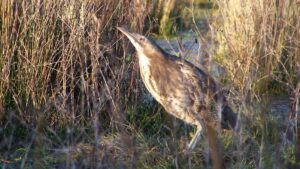 DOC Biodiversity Ranger Helen Jonas and a group of volunteers spent two evenings, one in October and one in November, simply listening. Over those two nights they identified around ten different booming male bittern: a phenomenal number for a bird this threatened.
Helen’s verdict has stayed with us:
“…whatever is being done out there is working! The Opoutama wetland is the hotspot for matuku in the Wairoa district.”
That result is down to years of steady, unglamorous work — the trapping and pest control that gives ground-nesting birds a chance. And it set the scene for what happened next.
Everyone in the same place, on the same day
This June, our reserve manager Jake Goonan visited Opoutama — and used the occasion to bring together everyone involved in caring for the wetland, on the same day, for a single purpose: to look after this place better.
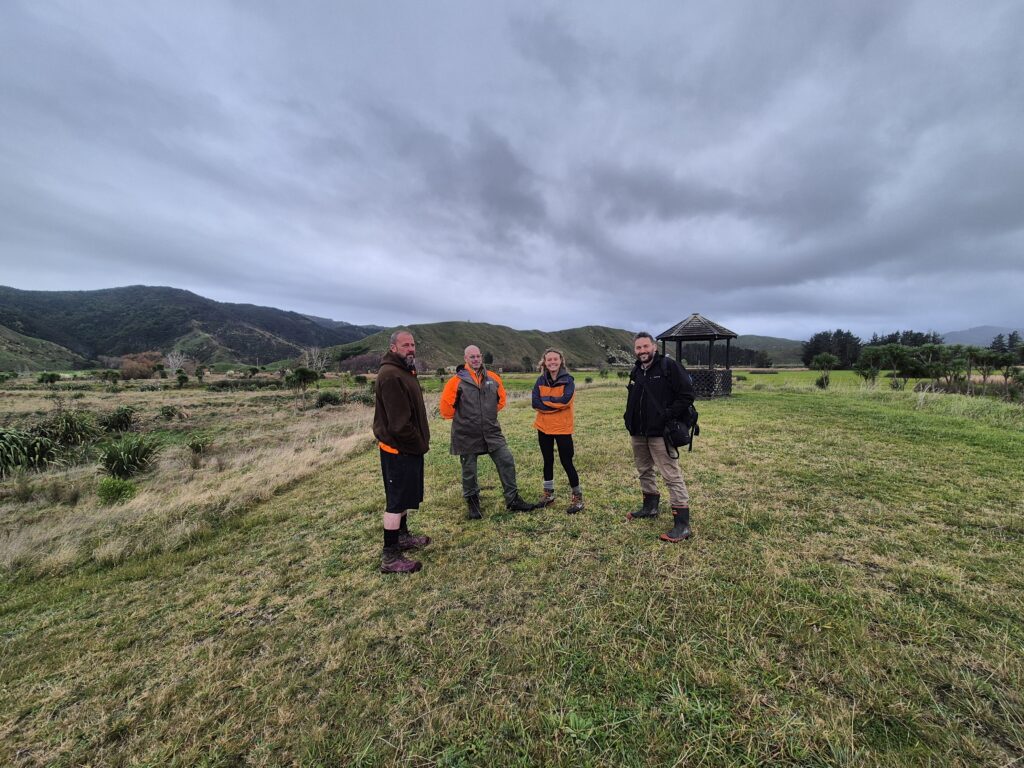
Staff from DOC, from QEII National Trust, from the Hawke’s Bay Regional Council, and our local pest control contractor all gathered on site. For a wetland that a small charity has quietly cared for over many years, having every agency in the region standing in the same reeds, looking at the same water, was a moment worth marking.
And it produced something real. The Hawke’s Bay Regional Council agreed to work more closely with us — on pest control, on monitoring (including the potential use of drones to survey the wetland), and on biodiversity funding — in recognition of just how special the site is as habitat for matuku and other threatened species.
Monitoring matters more than it might sound. Because the bittern is so cryptic, the only way to know whether the wetland is thriving is to count the booms — and better monitoring, done more often, means we can see whether the population is holding steady, growing or declining, and respond before it’s too late.
A step toward permanent protection
There is more coming. QEII’s Malcolm Rutherford is progressing a proposal to bring a newly acquired section of the wetland into permanent protection under a QEII covenant.
That proposal is still in progress — there’s still some way to go before it’s final. But the direction is clear, and it’s the one that matters most to us: a QEII covenant, once in place, can never be undone. It means the land it protects stays safe for ever, no matter who owns it or what pressures come. For a wetland that shelters one of our rarest birds, there is no better outcome to be working toward.
Why this is worth rallying around
When councils, agencies and a small charity all pull in the same direction, rare birds get a future. That’s the quiet lesson of Opoutama this year: a wetland full of matuku, a survey that proved the work is paying off, a region working together to protect it, and a covenant proposal now underway.
None of it happens without people who care enough to make it happen. That support is why Opoutama is still here, and why places like it can keep taking these important steps towards permanent protection.
If you’d like to help keep wetlands like Opoutama safe for the birds that depend on them, you can support the Trust’s work here.
New Zealand’s forests and wetlands — protected for all New Zealanders, for ever.